Optimization Function
In this context, the optimization function is the mathematical rule driving the platform to maximize user engagement and time spent, often at the cost of wellbeing, by targeting users in states of social depletion.
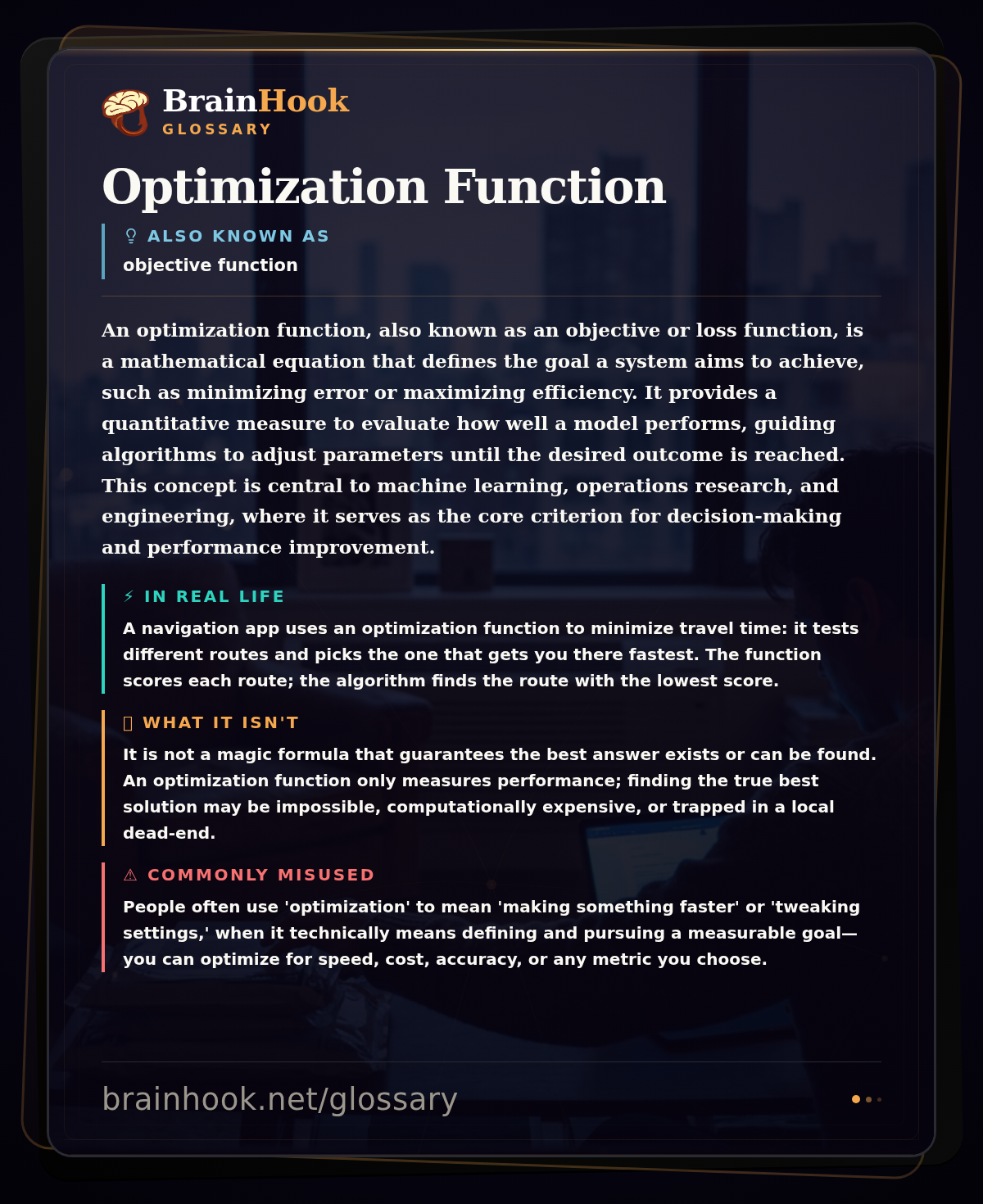
An optimization function, also known as an objective or loss function, is a mathematical equation that defines the goal a system aims to achieve, such as minimizing error or maximizing efficiency. It provides a quantitative measure to evaluate how well a model performs, guiding algorithms to adjust parameters until the desired outcome is reached. This concept is central to machine learning, operations research, and engineering, where it serves as the core criterion for decision-making and performance improvement.
What this means in real life
A navigation app uses an optimization function to minimize travel time: it tests different routes and picks the one that gets you there fastest. The function scores each route; the algorithm finds the route with the lowest score.
What it isn’t
It is not a magic formula that guarantees the best answer exists or can be found. An optimization function only measures performance; finding the true best solution may be impossible, computationally expensive, or trapped in a local dead-end.
Commonly misused online
People often use 'optimization' to mean 'making something faster' or 'tweaking settings,' when it technically means defining and pursuing a measurable goal—you can optimize for speed, cost, accuracy, or any metric you choose.