Neurodivergent
Refers to people whose neurological development and functioning differ significantly from the dominant societal standard, often including autism, ADHD, or dyslexia. It frames these differences as natural variations rather than disorders, highlighting how their nervous systems operate in ways that diverge from the norm.
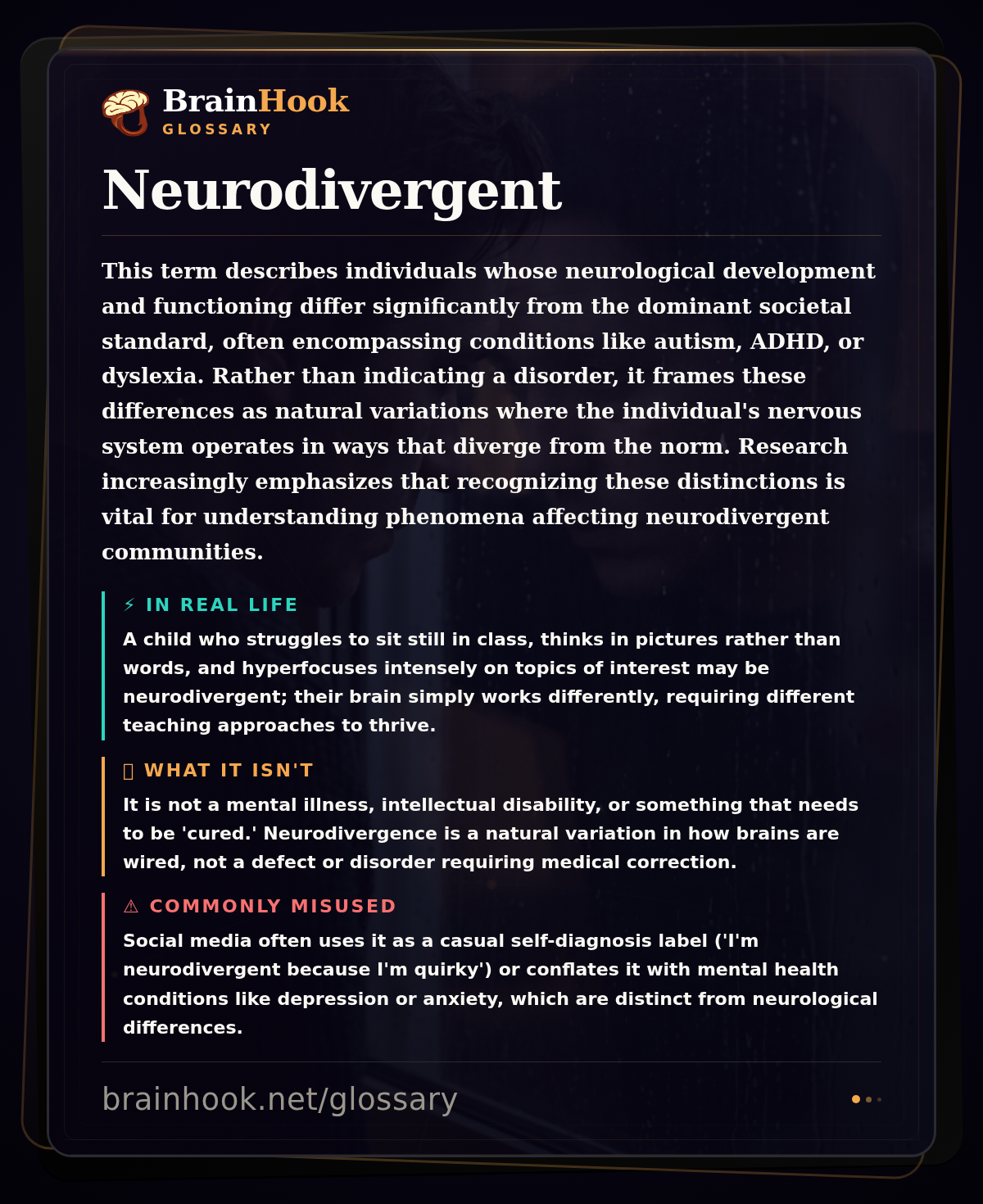
This term describes individuals whose neurological development and functioning differ significantly from the dominant societal standard, often encompassing conditions like autism, ADHD, or dyslexia. Rather than indicating a disorder, it frames these differences as natural variations where the individual's nervous system operates in ways that diverge from the norm. Research increasingly emphasizes that recognizing these distinctions is vital for understanding phenomena affecting neurodivergent communities.
What this means in real life
A child who struggles to sit still in class, thinks in pictures rather than words, and hyperfocuses intensely on topics of interest may be neurodivergent; their brain simply works differently, requiring different teaching approaches to thrive.
What it isn’t
It is not a mental illness, intellectual disability, or something that needs to be 'cured.' Neurodivergence is a natural variation in how brains are wired, not a defect or disorder requiring medical correction.
Commonly misused online
Social media often uses it as a casual self-diagnosis label ('I'm neurodivergent because I'm quirky') or conflates it with mental health conditions like depression or anxiety, which are distinct from neurological differences.