Loss Aversion
Loss aversion is the tendency to fear losing something more than you enjoy gaining something of equal value, making people avoid rational risks even when potential rewards exceed potential losses.
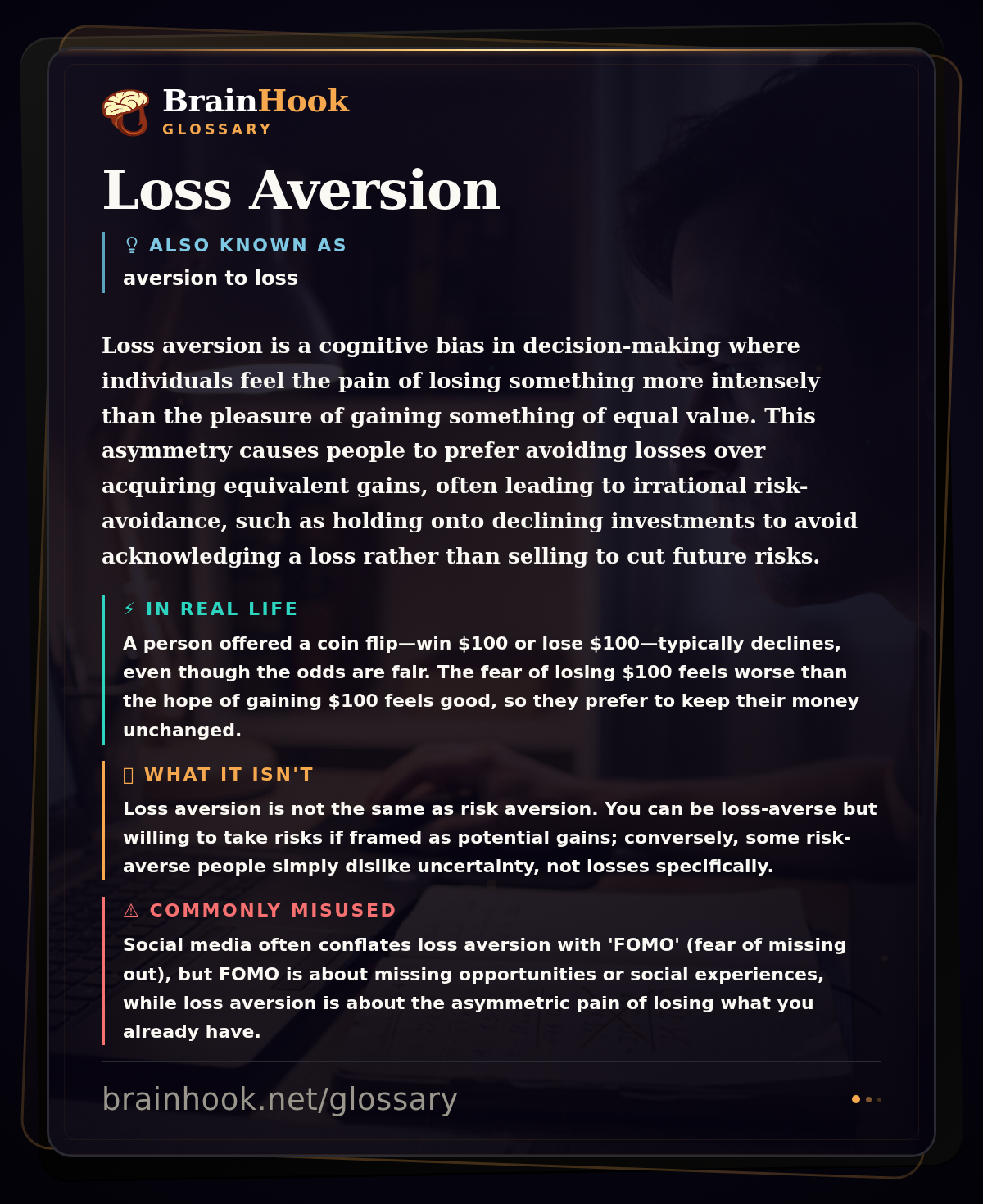
Loss aversion is a cognitive bias in decision-making where individuals feel the pain of losing something more intensely than the pleasure of gaining something of equal value. This asymmetry causes people to prefer avoiding losses over acquiring equivalent gains, often leading to irrational risk-avoidance, such as holding onto declining investments to avoid acknowledging a loss rather than selling to cut future risks.
What this means in real life
A person offered a coin flip—win $100 or lose $100—typically declines, even though the odds are fair. The fear of losing $100 feels worse than the hope of gaining $100 feels good, so they prefer to keep their money unchanged.
What it isn’t
Loss aversion is not the same as risk aversion. You can be loss-averse but willing to take risks if framed as potential gains; conversely, some risk-averse people simply dislike uncertainty, not losses specifically.
Commonly misused online
Social media often conflates loss aversion with 'FOMO' (fear of missing out), but FOMO is about missing opportunities or social experiences, while loss aversion is about the asymmetric pain of losing what you already have.