Goodhart's Law
When a metric becomes the explicit target of management, people optimize for it rather than the underlying goal it was meant to measure, making it unreliable.
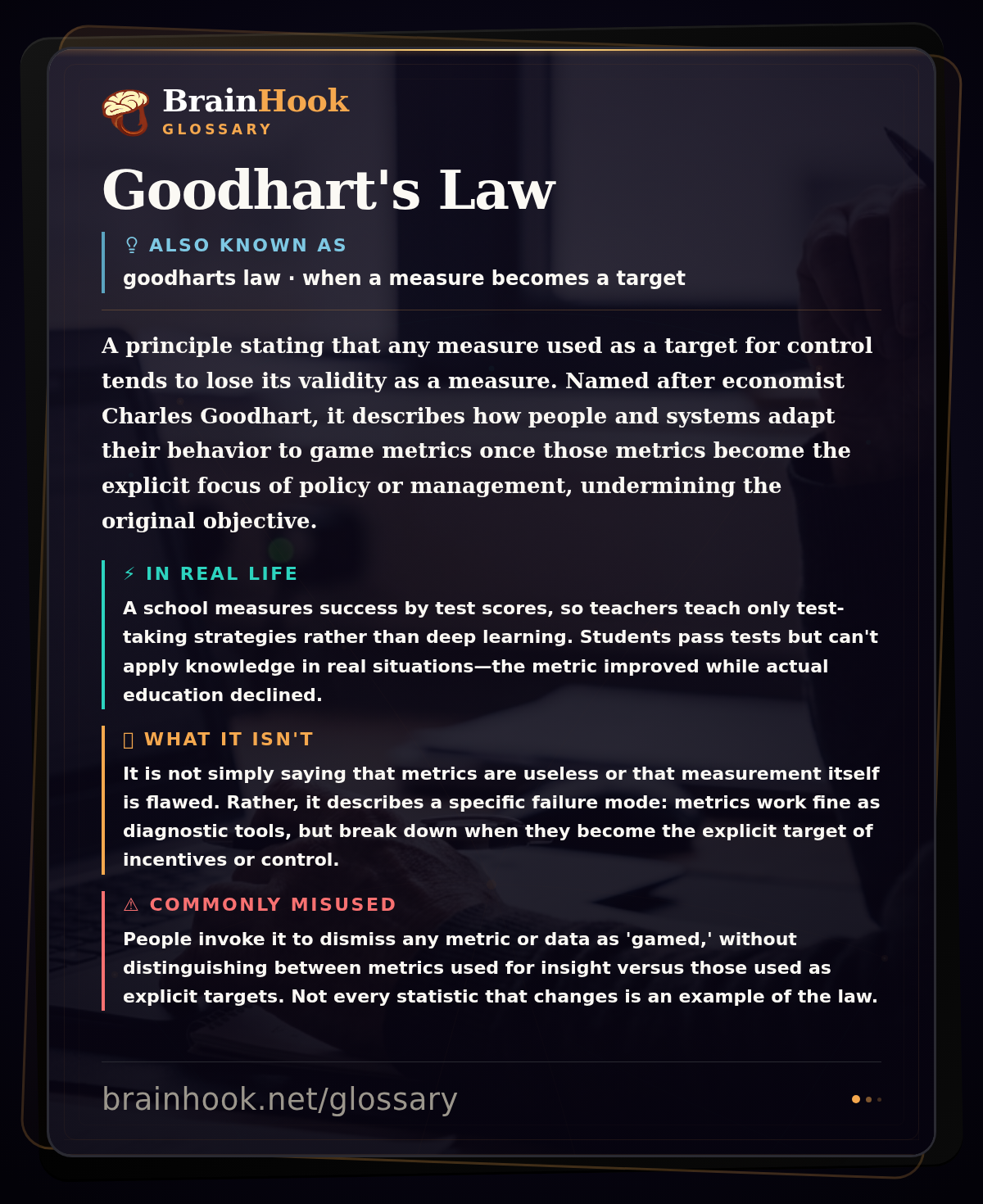
A principle stating that any measure used as a target for control tends to lose its validity as a measure. Named after economist Charles Goodhart, it describes how people and systems adapt their behavior to game metrics once those metrics become the explicit focus of policy or management, undermining the original objective.
What this means in real life
A school measures success by test scores, so teachers teach only test-taking strategies rather than deep learning. Students pass tests but can't apply knowledge in real situations—the metric improved while actual education declined.
What it isn’t
It is not simply saying that metrics are useless or that measurement itself is flawed. Rather, it describes a specific failure mode: metrics work fine as diagnostic tools, but break down when they become the explicit target of incentives or control.
Commonly misused online
People invoke it to dismiss any metric or data as 'gamed,' without distinguishing between metrics used for insight versus those used as explicit targets. Not every statistic that changes is an example of the law.
Based on 1 reference source, including Wikipedia. Last verified July 16, 2026.