Goal-directed Attention
Focused attention guided by a specific intention or search criterion—you're actively looking for something particular rather than passively consuming whatever appears.
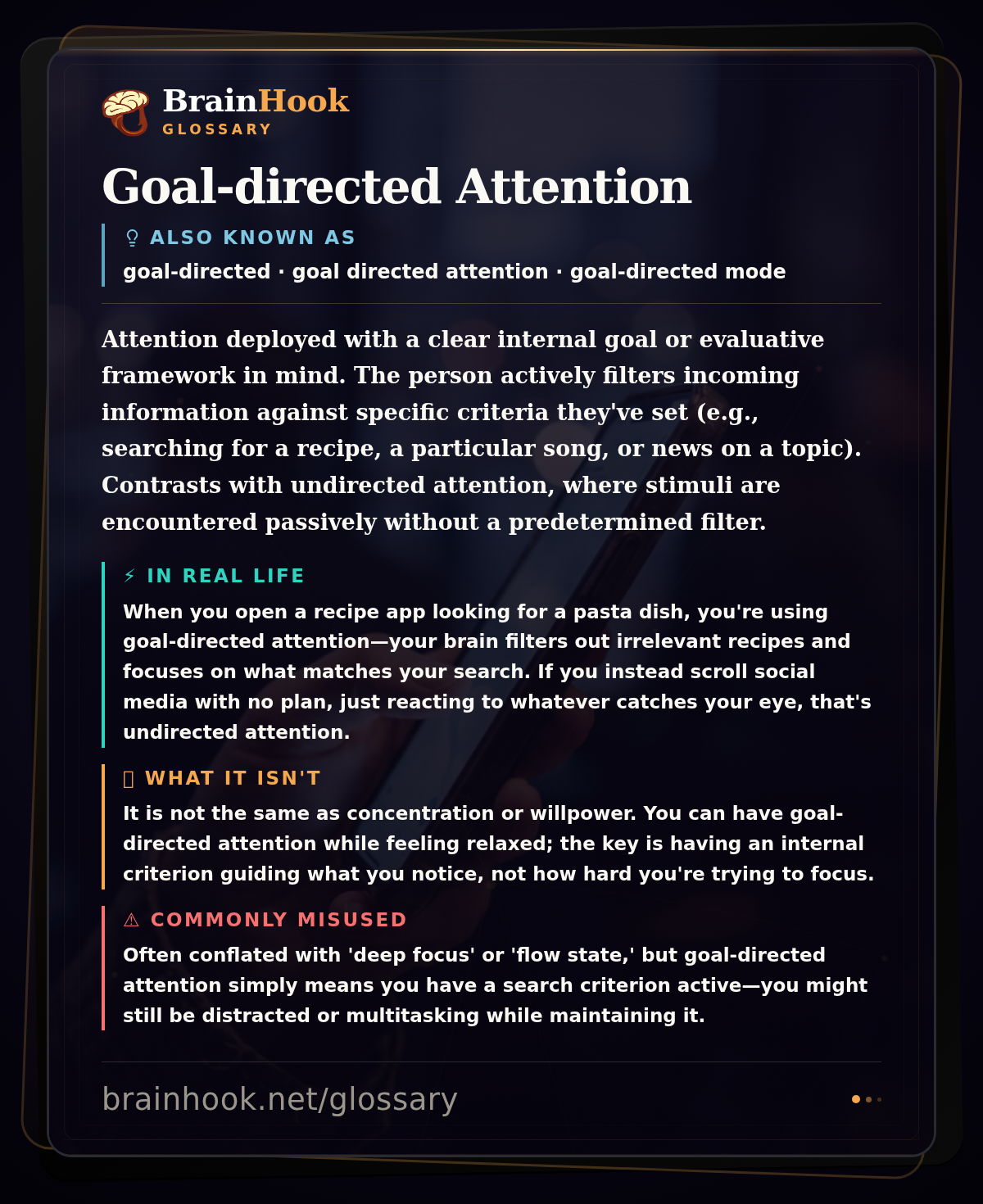
Attention deployed with a clear internal goal or evaluative framework in mind. The person actively filters incoming information against specific criteria they've set (e.g., searching for a recipe, a particular song, or news on a topic). Contrasts with undirected attention, where stimuli are encountered passively without a predetermined filter.
What this means in real life
When you open a recipe app looking for a pasta dish, you're using goal-directed attention—your brain filters out irrelevant recipes and focuses on what matches your search. If you instead scroll social media with no plan, just reacting to whatever catches your eye, that's undirected attention.
What it isn’t
It is not the same as concentration or willpower. You can have goal-directed attention while feeling relaxed; the key is having an internal criterion guiding what you notice, not how hard you're trying to focus.
Commonly misused online
Often conflated with 'deep focus' or 'flow state,' but goal-directed attention simply means you have a search criterion active—you might still be distracted or multitasking while maintaining it.
Based on 1 reference source, including peer-reviewed research. Last verified July 16, 2026.