Emotional Dysregulation
In clinical contexts, emotional dysregulation is the inability to manage intense emotional responses, often leading to overreactions or relationship instability. It involves a failure to modulate emotional intensity effectively.
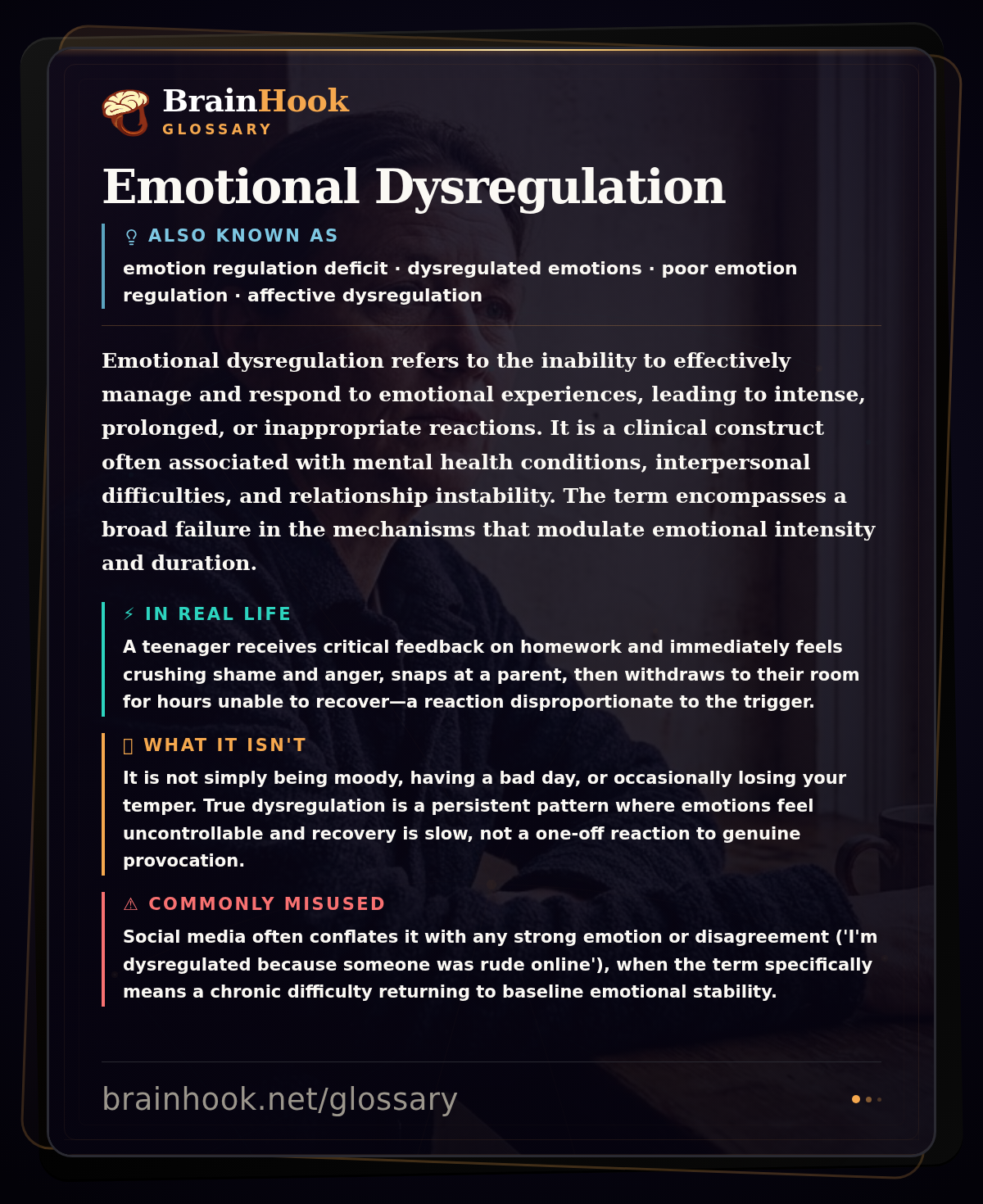
Emotional dysregulation refers to the inability to effectively manage and respond to emotional experiences, leading to intense, prolonged, or inappropriate reactions. It is a clinical construct often associated with mental health conditions, interpersonal difficulties, and relationship instability. The term encompasses a broad failure in the mechanisms that modulate emotional intensity and duration.
What this means in real life
A teenager receives critical feedback on homework and immediately feels crushing shame and anger, snaps at a parent, then withdraws to their room for hours unable to recover—a reaction disproportionate to the trigger.
What it isn’t
It is not simply being moody, having a bad day, or occasionally losing your temper. True dysregulation is a persistent pattern where emotions feel uncontrollable and recovery is slow, not a one-off reaction to genuine provocation.
Commonly misused online
Social media often conflates it with any strong emotion or disagreement ('I'm dysregulated because someone was rude online'), when the term specifically means a chronic difficulty returning to baseline emotional stability.
Based on 2 reference sources, including primary sources. Last verified July 12, 2026.