Echo Chambers
Online spaces where algorithms and social networks expose you mainly to views you already agree with, limiting exposure to opposing perspectives.
Not to be confused with: Filter Bubbles
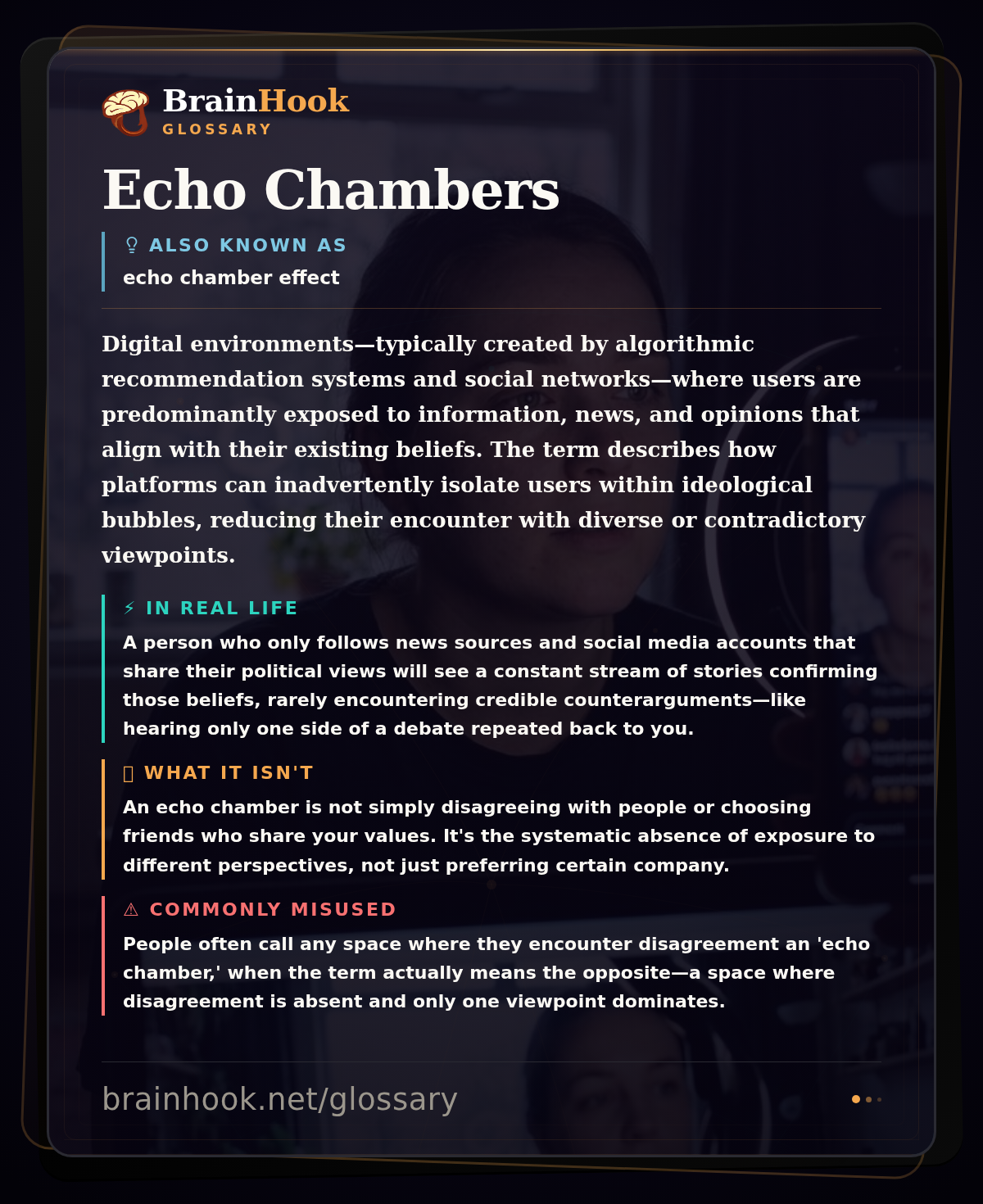
Digital environments—typically created by algorithmic recommendation systems and social networks—where users are predominantly exposed to information, news, and opinions that align with their existing beliefs. The term describes how platforms can inadvertently isolate users within ideological bubbles, reducing their encounter with diverse or contradictory viewpoints.
What this means in real life
A person who only follows news sources and social media accounts that share their political views will see a constant stream of stories confirming those beliefs, rarely encountering credible counterarguments—like hearing only one side of a debate repeated back to you.
What it isn’t
An echo chamber is not simply disagreeing with people or choosing friends who share your values. It's the systematic absence of exposure to different perspectives, not just preferring certain company.
Commonly misused online
People often call any space where they encounter disagreement an 'echo chamber,' when the term actually means the opposite—a space where disagreement is absent and only one viewpoint dominates.
Based on 1 reference source, including primary sources. Last verified July 14, 2026.