Context Switch
The mental effort and time lost when shifting attention between different tasks or activities, disrupting focus and slowing performance.
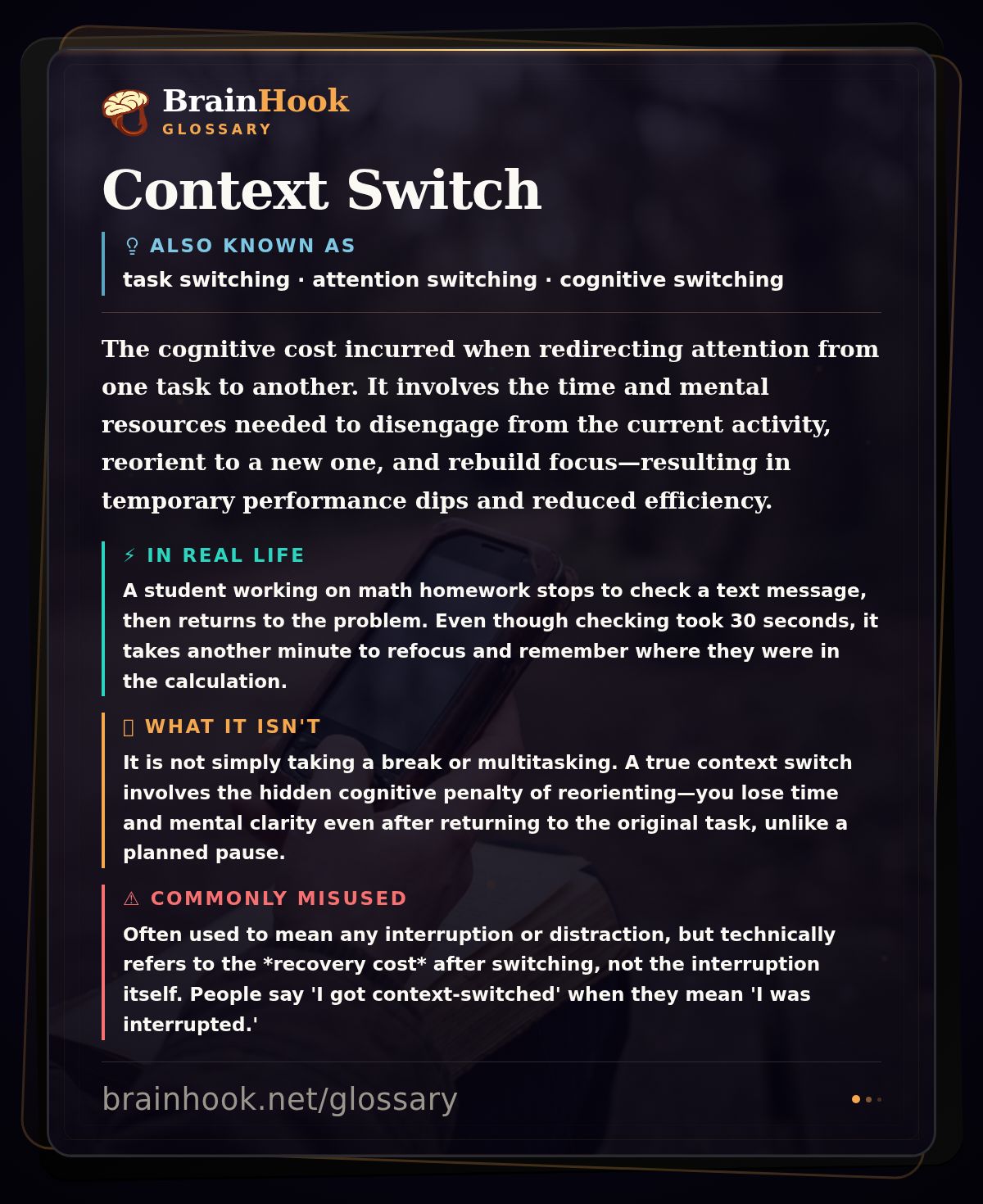
The cognitive cost incurred when redirecting attention from one task to another. It involves the time and mental resources needed to disengage from the current activity, reorient to a new one, and rebuild focus—resulting in temporary performance dips and reduced efficiency.
What this means in real life
A student working on math homework stops to check a text message, then returns to the problem. Even though checking took 30 seconds, it takes another minute to refocus and remember where they were in the calculation.
What it isn’t
It is not simply taking a break or multitasking. A true context switch involves the hidden cognitive penalty of reorienting—you lose time and mental clarity even after returning to the original task, unlike a planned pause.
Commonly misused online
Often used to mean any interruption or distraction, but technically refers to the *recovery cost* after switching, not the interruption itself. People say 'I got context-switched' when they mean 'I was interrupted.'