Cognitive Components
These are the mental processes that let you understand what another person thinks or feels without necessarily sharing their emotions, such as reading social cues or inferring distress through reasoning.
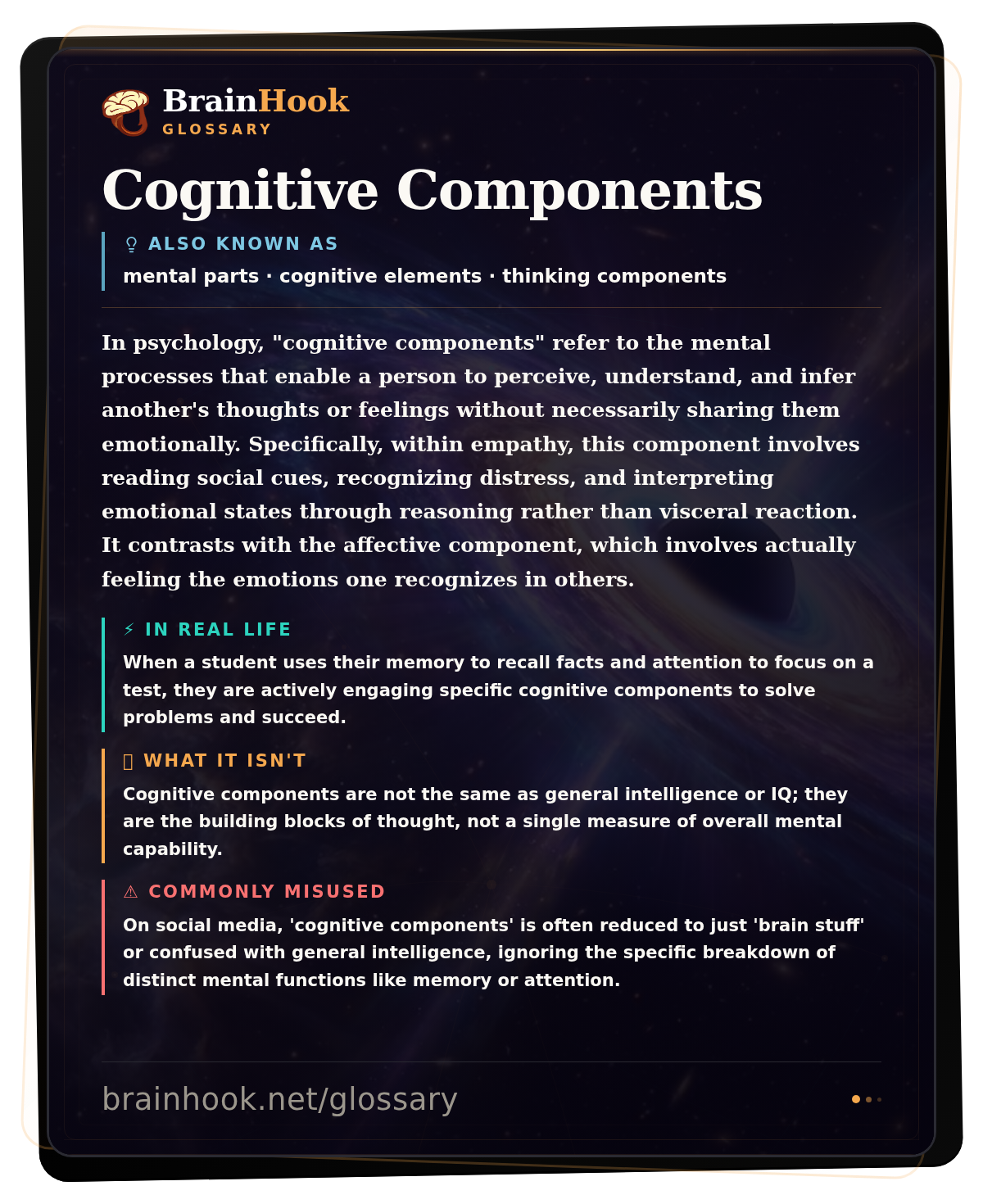
In psychology, "cognitive components" refer to the mental processes that enable a person to perceive, understand, and infer another's thoughts or feelings without necessarily sharing them emotionally. Specifically, within empathy, this component involves reading social cues, recognizing distress, and interpreting emotional states through reasoning rather than visceral reaction. It contrasts with the affective component, which involves actually feeling the emotions one recognizes in others.
What this means in real life
When a student reads a textbook chapter, attention focuses on the words, perception decodes the letters, memory retrieves related knowledge, and reasoning connects new ideas to old ones—each component working in concert to build understanding.
What it isn’t
Not a single unified mental ability or IQ score. Cognitive components are the separate, measurable processes that together create overall mental function; they're not one monolithic 'thinking power.'
Commonly misused online
Often conflated with 'cognitive skills' or 'cognitive abilities,' which are learned or developed capacities. Components are the foundational mental processes themselves, not the skills built on top of them.
Based on 3 reference sources, including NIH material. Last verified July 11, 2026.