Attention Fragmentation
The splitting of mental focus across multiple tasks or stimuli, reducing the depth of attention on any single one.
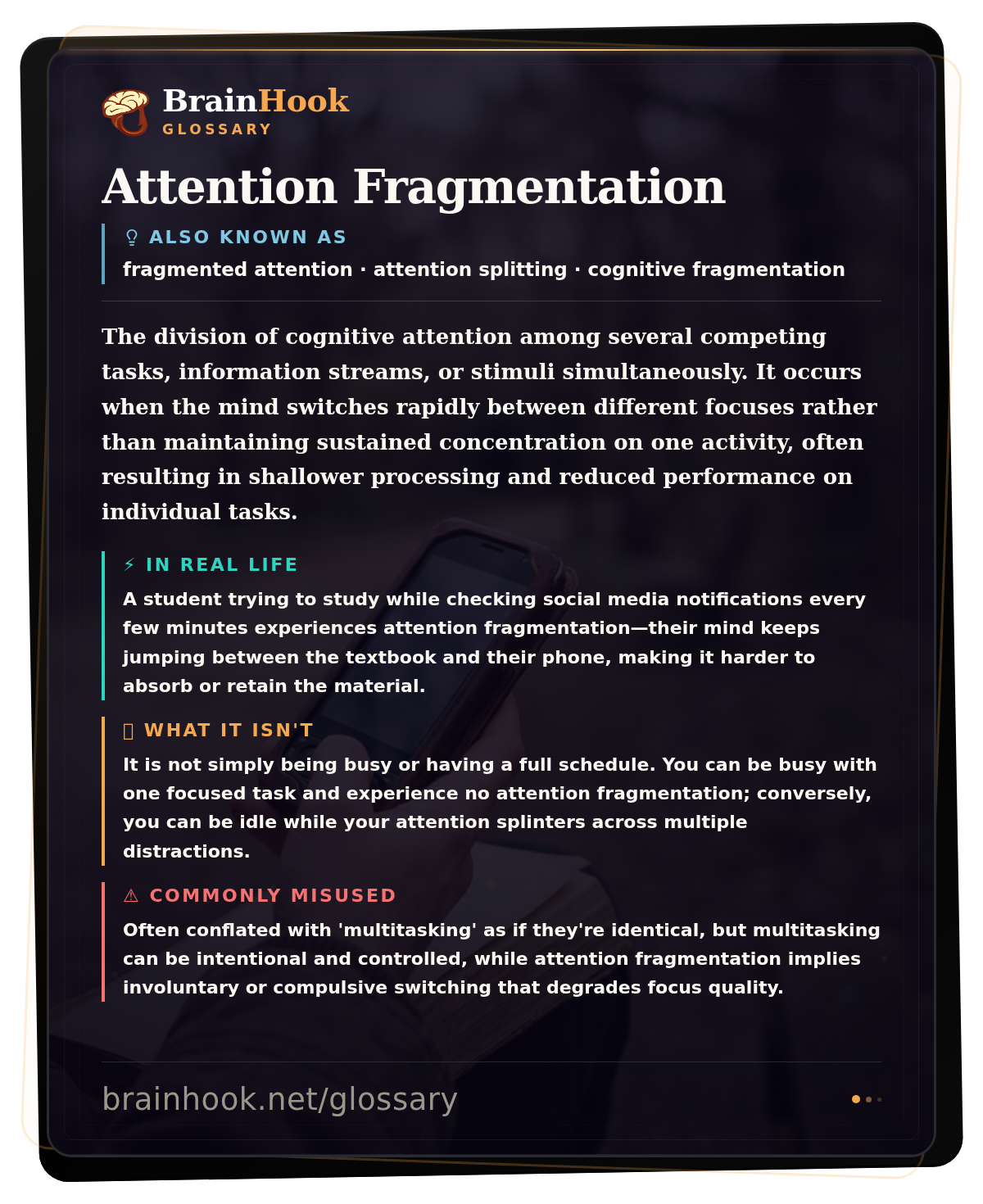
The division of cognitive attention among several competing tasks, information streams, or stimuli simultaneously. It occurs when the mind switches rapidly between different focuses rather than maintaining sustained concentration on one activity, often resulting in shallower processing and reduced performance on individual tasks.
What this means in real life
A student trying to study while checking social media notifications every few minutes experiences attention fragmentation—their mind keeps jumping between the textbook and their phone, making it harder to absorb or retain the material.
What it isn’t
It is not simply being busy or having a full schedule. You can be busy with one focused task and experience no attention fragmentation; conversely, you can be idle while your attention splinters across multiple distractions.
Commonly misused online
Often conflated with 'multitasking' as if they're identical, but multitasking can be intentional and controlled, while attention fragmentation implies involuntary or compulsive switching that degrades focus quality.
Based on 2 reference sources, including government sources. Last verified July 16, 2026.