Attachment Wounds
Deep relational injuries from childhood when caregivers were inconsistent or conditional, making individuals believe worth depends on effort. Love feels like a struggle to sustain, not something that naturally exists, often causing insecure attachment patterns in adulthood.
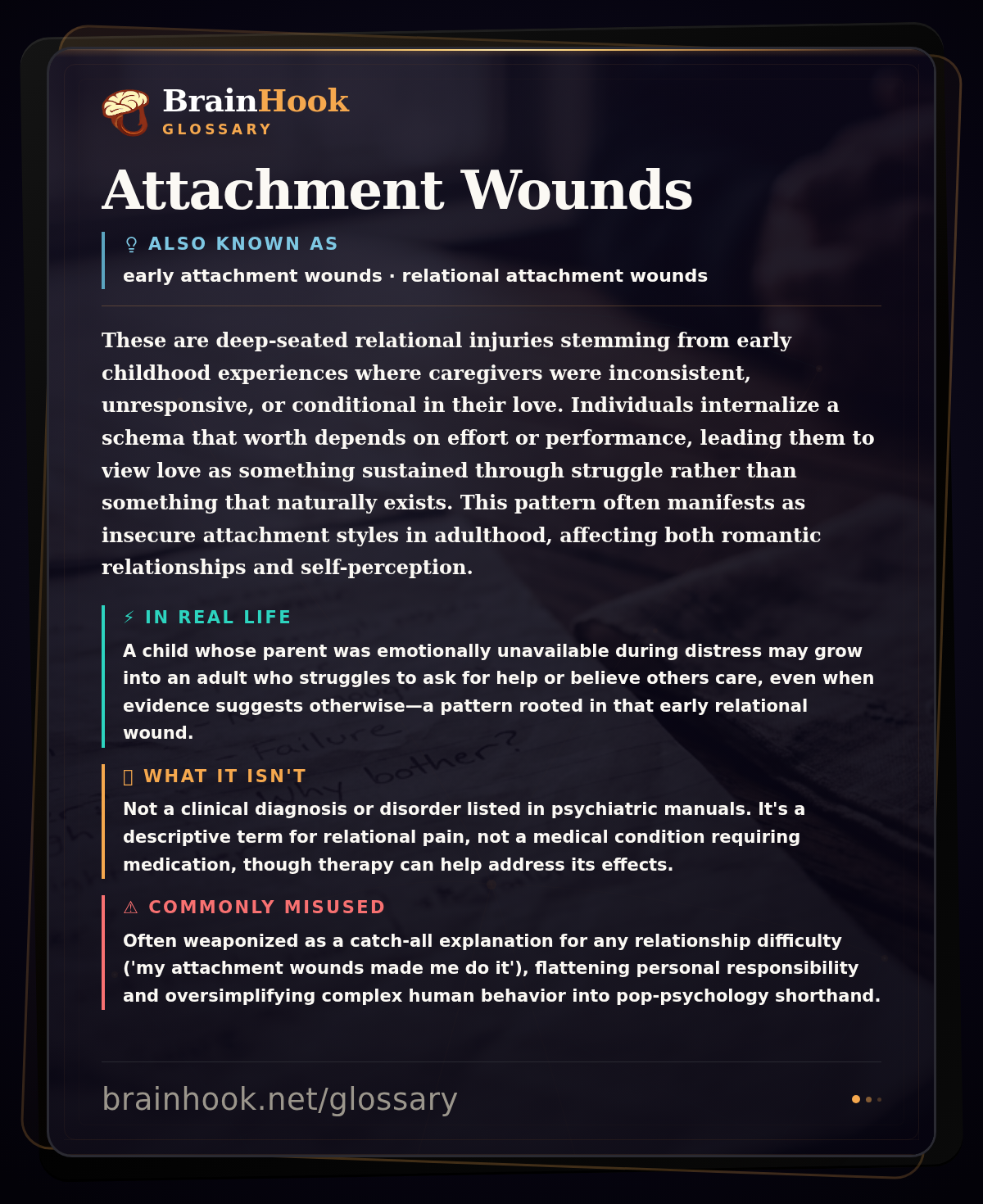
These are deep-seated relational injuries stemming from early childhood experiences where caregivers were inconsistent, unresponsive, or conditional in their love. Individuals internalize a schema that worth depends on effort or performance, leading them to view love as something sustained through struggle rather than something that naturally exists. This pattern often manifests as insecure attachment styles in adulthood, affecting both romantic relationships and self-perception.
What this means in real life
A child whose parent was emotionally unavailable during distress may grow into an adult who struggles to ask for help or believe others care, even when evidence suggests otherwise—a pattern rooted in that early relational wound.
What it isn’t
Not a clinical diagnosis or disorder listed in psychiatric manuals. It's a descriptive term for relational pain, not a medical condition requiring medication, though therapy can help address its effects.
Commonly misused online
Often weaponized as a catch-all explanation for any relationship difficulty ('my attachment wounds made me do it'), flattening personal responsibility and oversimplifying complex human behavior into pop-psychology shorthand.