Alloreactive Immune Responses
These are T-cell reactions targeting non-self (allogeneic) antigens from transplants, causing graft rejection via foreign protein recognition, distinct from autoimmune responses.
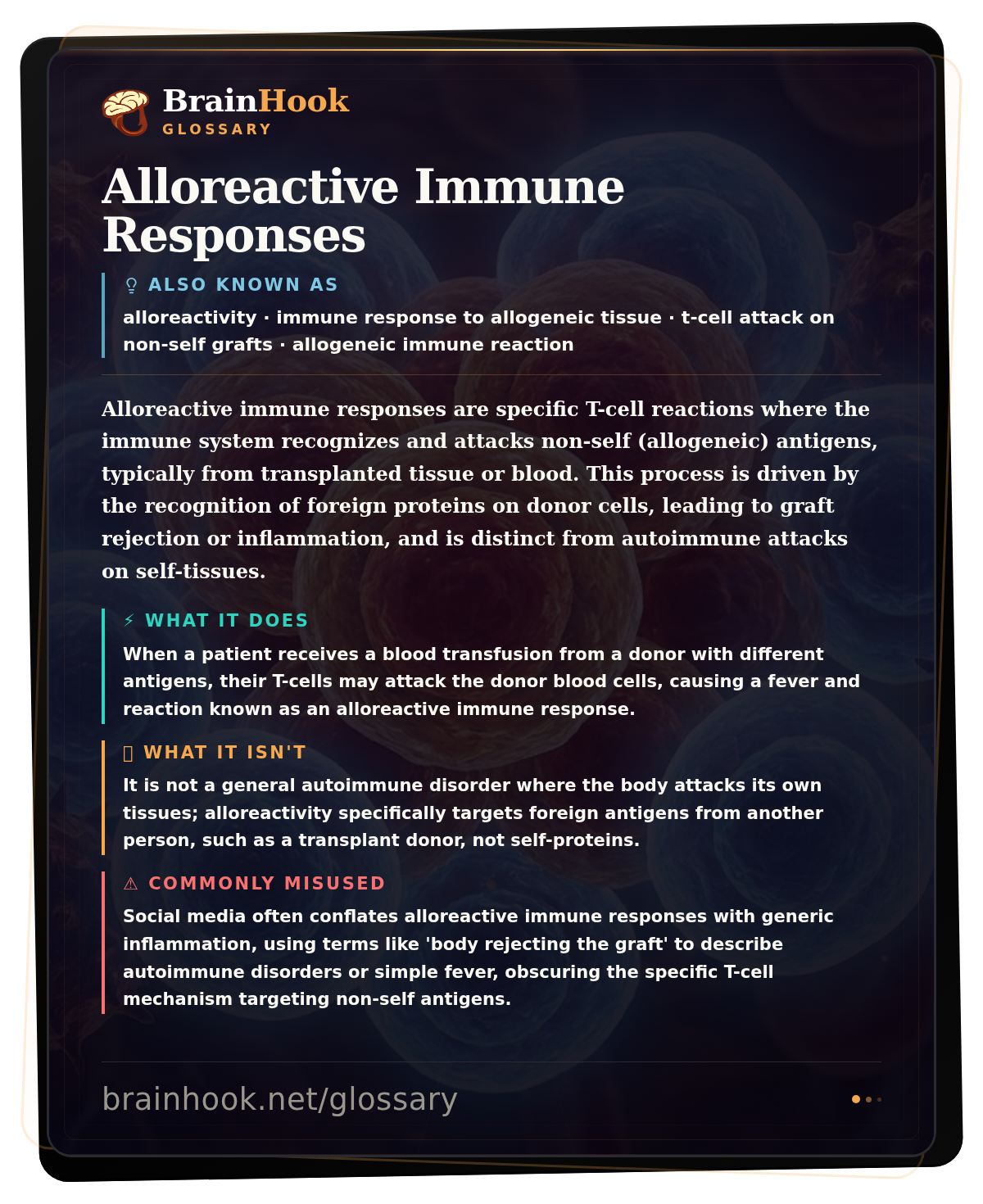
Alloreactive immune responses are specific T-cell reactions where the immune system recognizes and attacks non-self (allogeneic) antigens, typically from transplanted tissue or blood. This process is driven by the recognition of foreign proteins on donor cells, leading to graft rejection or inflammation, and is distinct from autoimmune attacks on self-tissues.
What this means in real life
When a patient receives a kidney transplant from a donor, their immune system may attack the new kidney because it recognizes the donor's cells as 'not self,' causing inflammation and organ damage unless immunosuppressive drugs prevent the reaction.
What it isn’t
This is not an autoimmune response, where the body attacks its own tissues. Alloreactive responses target genuinely foreign tissue from another person, whereas autoimmunity involves a breakdown of self-tolerance.
Commonly misused online
People sometimes use 'alloreactive' interchangeably with 'allergic,' but allergies involve hypersensitivity to harmless substances like pollen, while alloreactive responses are directed at foreign human cells or tissues.