Affective Neuroscience
The scientific study of how emotions arise from brain activity and neural circuits, bridging neurobiology and psychology.
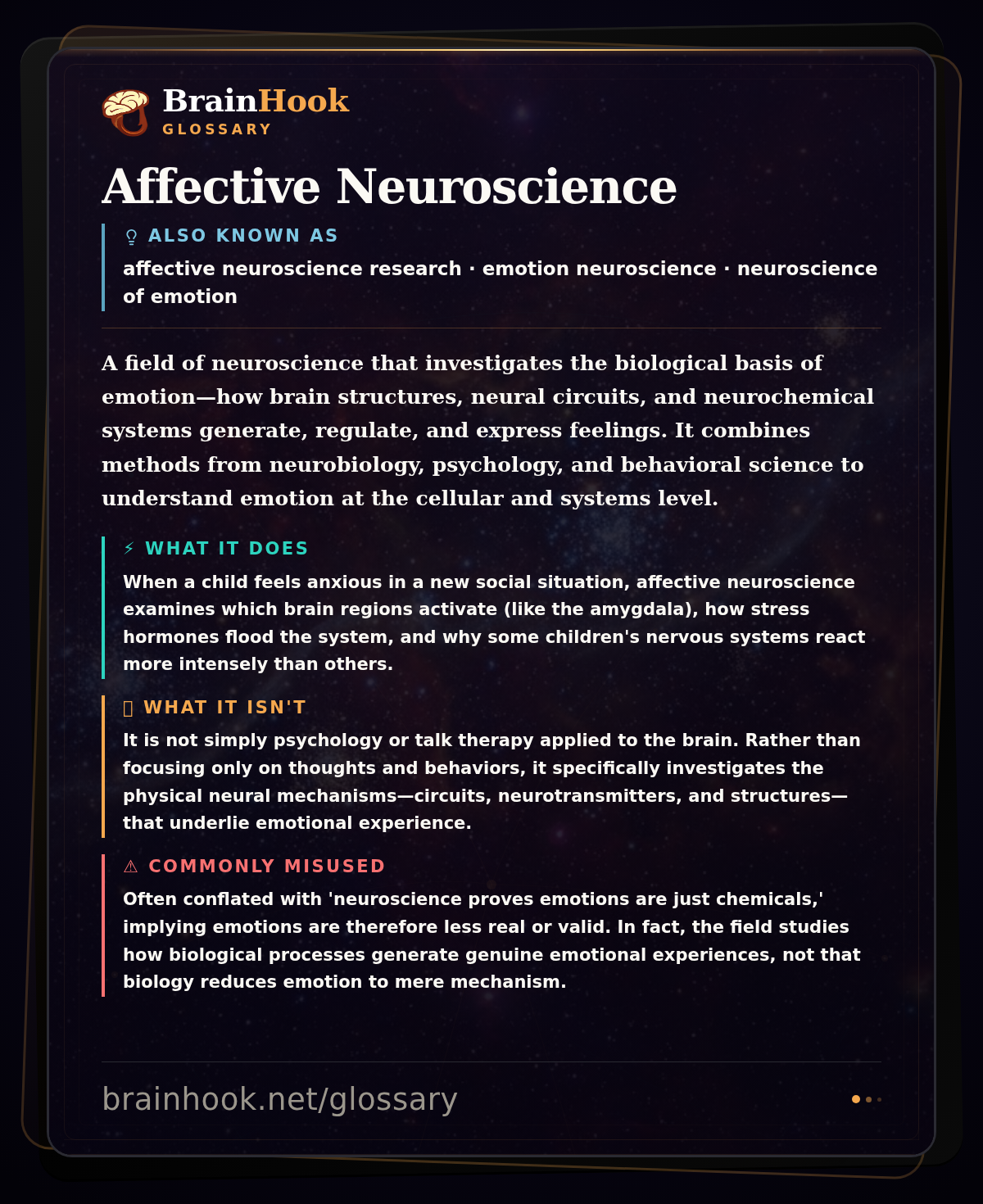
A field of neuroscience that investigates the biological basis of emotion—how brain structures, neural circuits, and neurochemical systems generate, regulate, and express feelings. It combines methods from neurobiology, psychology, and behavioral science to understand emotion at the cellular and systems level.
What this means in real life
When a child feels anxious in a new social situation, affective neuroscience examines which brain regions activate (like the amygdala), how stress hormones flood the system, and why some children's nervous systems react more intensely than others.
What it isn’t
It is not simply psychology or talk therapy applied to the brain. Rather than focusing only on thoughts and behaviors, it specifically investigates the physical neural mechanisms—circuits, neurotransmitters, and structures—that underlie emotional experience.
Commonly misused online
Often conflated with 'neuroscience proves emotions are just chemicals,' implying emotions are therefore less real or valid. In fact, the field studies how biological processes generate genuine emotional experiences, not that biology reduces emotion to mere mechanism.
Based on 1 reference source, including NIH material. Last verified July 16, 2026.